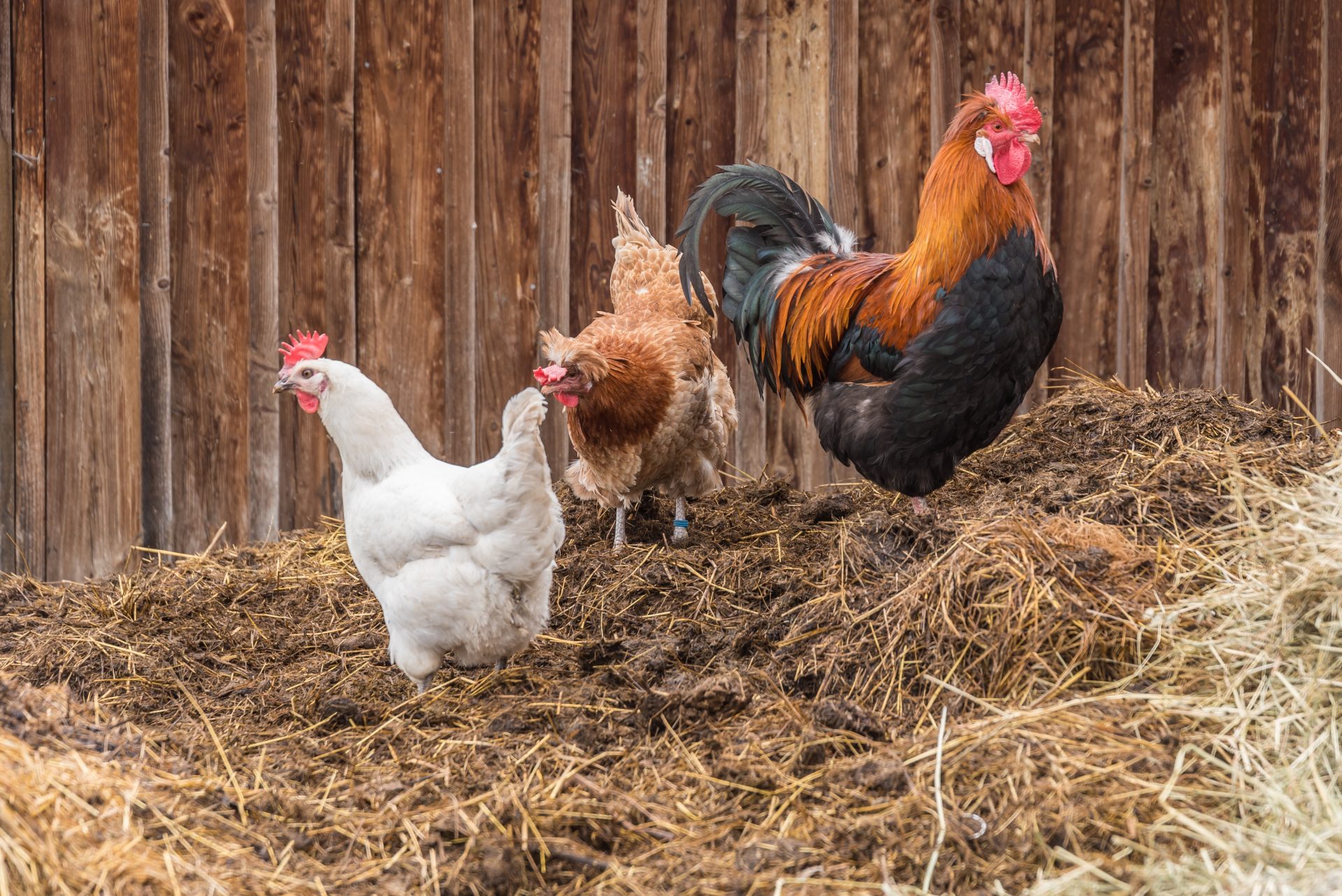
Poultry manure is the solid or semi-solid effluent from poultry farms, consisting of excreta, any bedding material (straw, wood shavings or other lignocellulosic materials), feathers and small quantities of spilled feed. It is an organic matrix available in large quantities, given the widespread presence of poultry farming in Italy. While offering interesting agronomic performance, it requires careful management due to the potential environmental implications associated with its use in agriculture and must necessarily be applied after appropriate treatment, also to prevent phytotoxicity.
Indice
- Where does poultry manure used as fertilizer come from?
- The chemical composition of poultry manure
- Benefits of using poultry manure as fertilizer
- Limitations and risks associated with the use of poultry manure as fertilizer
- Treatments applied to poultry manure before agronomic use
- Poultry manure and organic matrix quality
- Agribios tips
Subscribe to the newsletter
Subscribe now
Where does poultry manure used as fertilizer come from?
According to Ismea, Italian poultry farming is a significant sector. At the end of 2024, Italian farms housed more than 140 million domestic birds across approximately 6,700 farms. More than half of these birds are meat chickens (broilers), while the remainder consists of laying hens and turkeys, with farms heavily concentrated in Veneto, Lombardy and Emilia-Romagna.
Birds can be raised in cages, indoor in intensive farming systems, or outdoors, and the farming system adopted affects the moisture and dry matter content of the excreta reaching fertilizer production facilities. Moisture tends to be higher in cage farming systems (approximately 50-60%) than in indoor floor-based systems (20-30%).
There are no official statistics on the volumes of poultry manure produced in Italy. Applying livestock excretion coefficients to the number of birds results in estimates of several million tonnes per year, but this is an approximate calculation rather than census data.
The chemical composition of poultry manure
The composition of poultry manure is highly variable: it depends on the species raised, the feed provided, the farming system and whether bedding is used, among other factors.
Poultry manure is rich in Nitrogen, Phosphorus and Potassium, and a significant proportion of the Nitrogen is present in uric and ammoniacal forms, making it potentially available relatively quickly.
Its low C/N ratio also makes it readily mineralizable. The same characteristics that make poultry manure a good fast-acting fertilizer are also responsible for its main drawback: when used untreated, it promotes Nitrogen losses as ammonia and urea and can cause root burn in crops. For this reason, it must undergo processes such as composting and/or drying before use, which also help reduce any potential load of pathogenic microorganisms and unpleasant odours. Poultry manure is also naturally rich in Calcium, Magnesium, Sulphur and micronutrients such as Iron, Boron and Manganese.
As a general indication, fresh laying-hen manure has a moisture content of 60-75%, while broiler litter (consisting of a mixture of excreta and plant materials) ranges between 20 and 35%. When dried or pelleted (dry matter above 80-85%), typical nutrient contents are around 3-5% N, 2-4% P₂O₅ and 2-3% K₂O. These values are indicative: variability between batches, related to feed, bedding and management, means that analytical characterization of each batch is necessary.
Benefits of using poultry manure as fertilizer
High nutrient density: primarily supplies N and P, as well as K, Ca, Mg, S and micronutrients.
Relatively rapid Nitrogen availability: useful for crops with high nutrient demand, provided that application timing and rate are synchronized with crop uptake.
Organic matter supply: improves microbial activity and the physical properties of the soil, particularly after composting or blending with matrices characterized by a high C/N ratio.
Amendment effect: its carbonate and base cation content can exert a moderate alkalizing effect in acidic soils, varying according to origin and treatment.
Circular economy: recovers on-farm nutrients, limits fertilizer purchases and, when incorporated into anaerobic digestion, also enables energy recovery.
Limitations and risks associated with the use of poultry manure as fertilizer
Unbalanced nutrient ratio: the amount required to meet Nitrogen needs often exceeds crop Phosphorus requirements, while K may not fully meet crop demand.
Ammonia volatilization: pH, temperature, wind and failure to incorporate the material into the soil promote N losses, odours and secondary formation of atmospheric particulate matter.
Leaching and runoff: the nitrate formed can reach groundwater and surface waters, while Phosphorus is transported mainly through erosion and soil particles.
Salinity and phytotoxicity: soluble salts, ammonium and unstable organic acids can damage seeds and roots, particularly when fresh poultry manure is used, at high application rates, in dry soils or with sensitive crops.
Health and hygiene risk: untreated material may contain pathogenic microorganisms and parasite eggs; contamination of edible products and water must be prevented.
Emissions and odours: storage and application can generate NH₃, N₂O, CH₄, dust and odorous compounds.
Contaminants: copper, zinc, veterinary residues and other contaminants depend on the supply chain.
Treatments applied to poultry manure before agronomic use
On-farm storage. Poultry manure can be stored on an impermeable surface and protected from rainwater, before being applied as livestock effluent in compliance with the Nitrates Directive. Storage reduces moisture and allows partial biological transformation, but does not automatically constitute composting nor does it guarantee sanitization. It is the simplest and least expensive option, but is associated with the greatest variability, ammonia losses, odours and health risks.
Aerobic composting and co-composting. Poultry manure is mixed with Carbon-rich bulking materials (straw, wood chips, pruning residues, suitable sawdust) to adjust moisture, porosity and the C/N ratio. Turned windrows, aerated platforms or enclosed reactors ensure oxygenation; a controlled thermophilic phase is followed by maturation. The process reduces fermentability, odours and pathogens, converts part of the Nitrogen into more stable organic forms and produces a more homogeneous material.
Drying, dehydration and heat treatment. Water can be removed by means of belt ventilation, hot air, tunnels, drums or protected solar drying. Reducing water content means limiting fermentation, odours and microbial growth, reducing mass and volume and facilitating transport, dosing and subsequent granulation. A validated heat treatment can contribute to sanitization, but does not guarantee it, and the temperatures applied may cause ammonia losses.
Pelleting, granulation and formulation. After drying and screening, poultry manure can be ground, pelleted or granulated. It can also be blended with other organic or mineral matrices to obtain more balanced N-P-K formulations. Densification improves homogeneity, storability, transport and application accuracy and reduces dust compared with finely ground material.
Other possible treatments include anaerobic digestion or thermochemical processes such as pyrolysis.
Poultry manure and organic matrix quality
The considerations above highlight a concept that Agribios has always supported: the need to start with carefully selected, top-quality organic matrices to produce effective fertilizers that respect the environment and are capable not only of nourishing crops, but also of protecting and regenerating soil fertility as a whole. At Agribios, poultry manure, like other organic matrices, undergoes a slow maturation process lasting approximately 180 days, carried out entirely in a covered, ventilated environment protected from sunlight. Production takes place without the use of drying ovens, to avoid destroying microbial flora, followed by cold pelleting.
Agribios tips
Agripollina is an organic fertilizer whose highly humified organic matter not only ensures a gradual release of nutrients over time, reducing losses through leaching, evaporation and immobilization, but also has a beneficial effect on the physical characteristics of the soil (porosity, water-holding capacity) and stimulates the vitality and biodiversity of the rhizosphere microbiota. The pellet formulation provides greater protection and a more gradual release of nutrients compared with a granular formulation. In addition, the pellet retains larger quantities of water within its structure than a granule. The release of this water into the rhizosphere may promote nutrient bioavailability and reduce the risk of soil salinization. Agripollina is permitted for use in organic farming.
Prodotti correlati

Agripollina
Organic fertilizers


Subscribe to the newsletter
Subscribe now
