Crop focus •
3 July 2025

Fertilizing and managing stress in potato cultivation

Originally from the Andean regions, the potato is now widespread globally and represents an important crop for Europe, where it is mainly produced in Germany, France, and the Netherlands. According to Eurostat data, in 2023, Europe produced 48.3 million tonnes of potatoes, continuing a downward trend that has persisted since 2000.

In Italy — currently ranked eighth among European countries and thirty-eighth worldwide in terms of production volume — structured cultivation began in the 19th century.

The potato production calendar

Potato cultivation is widespread throughout Italy. This is thanks to the possibility of cultivating potatoes in different periods of the year and under various climatic conditions. From a production calendar perspective, we can distinguish:

  • Early potatoes: harvested from February to June, sown in winter in southern and island regions.

  • Main-season potatoes: harvested from June to October, sown from February onwards.

  • Late-season potatoes: autumn production, from November to January, increasingly appreciated by the market.

Italy stands out for the quality of its potatoes — evidenced by the numerous PDO and PGI certifications — both for fresh consumption and for the agro-industry, as well as for the adoption of advanced technologies in industrial processing.

Agronomic aspects of potato cultivation

In 2024, Italy produced approximately 1.3 million tonnes of potatoes across 47,000 hectares.

It was a challenging season, due to extreme weather events: abundant spring rains delayed sowing, while summer heatwaves blocked photosynthesis and consequently the accumulation of starch in the tubers, even where irrigation was used to mitigate water stress.

The potato prefers temperate-cool climates. Optimal temperatures for plant development range between 15 and 20 °C, with both spring frosts and temperatures above 30 °C being detrimental.

Although it is a moderately water-demanding crop, the potato requires a constant water supply, especially during flowering. Drought, particularly when associated with high temperatures, drastically reduces tuber quality and size.

Potatoes require light, loose, permeable soils rich in organic matter. Proper soil aeration is essential. The ideal pH ranges from 6 to 6.5, with good tolerance up to 7.5.

Potato fertilization: focus on Potassium and Nitrogen

In Italian potato cultivation, yields vary significantly: they can exceed 45–50 t/ha in the most suitable areas, while the national average ranges between 25 and 30 t/ha.

A key element for achieving high-quality, high-yield production is fertilization. Since the potato’s root system is not very extensive, the crop cannot exploit deep soil resources. Therefore, proper management of the plant’s nutritional needs is fundamental to obtain a quality product.

The key macronutrients are Potassium and Nitrogen.

Nitrogen plays a fundamental role, especially in the early stages of the crop cycle. Although potatoes are considered potassium-loving (potassophilous) plants, they respond more markedly to nitrogen fertilization than to potassium. Adequate nitrogen availability at the beginning favors the development of vigorous leaf mass, necessary for effective photosynthesis and carbohydrate translocation to the tubers. Excess nitrogen must absolutely be avoided, as it can cause vegetative-productive imbalances, delaying tuberization and tuber maturation.

Potassium positively influences production, mainly by acting on carbohydrate metabolism. It also regulates cell osmotic turgor and water balance, enhancing resistance to drought conditions. Potassium contributes to larger tuber size and helps prevent physiological disorders such as internal browning.

Phosphorus, though absorbed in much smaller quantities compared to Nitrogen and Potassium, is crucial for stimulating root system development. Additionally, it promotes tuber formation and enlargement and accelerates maturation, giving the crop greater earliness. As previously discussed in other in-depth articles, phosphorus is often present in large quantities in cultivated soils but is poorly available to plants due to insolubilization phenomena.

Major biotic threats in potato cultivation

While thermal and water stress are the main environmental challenges in potato cultivation, the most dangerous biotic threats include:

  • Late blight (Phytophthora infestans), particularly severe in organic production systems.

  • Early blight (Alternaria solani), mainly affecting late varieties.

  • Colorado potato beetle (Leptinotarsa decemlineata): the main defoliating insect.

  • Potato tuber moth (Phthorimaea operculella): a lepidopteran pest harmful both in the field and during storage.

  • Wireworms (Agriotes spp.): beetles whose larvae damage tubers and roots.

  • Cyst nematodes (Globodera spp.) and root-knot nematodes (Meloidogyne spp.), increasingly widespread.

Agribios tips

The use of organic and organo-mineral fertilizers in potato fertilization allows multiple objectives to be achieved, ultimately improving the effectiveness and efficiency of this cultivation practice.

In addition to meeting the crop’s nutritional needs, the addition of organic matter provides the following advantages:

  • Improves soil porosity and softness, facilitating tuber development.

  • Increases the soil’s cation exchange capacity, reducing nutrient leaching and keeping nutrients within the root zone.

  • Enhances the soil’s water retention capacity, reducing the risk of stress during periods of low rainfall (and when irrigation is not possible) in the hottest months.

  • Stimulates the activity of microorganisms capable of promoting phosphorus solubilization in the soil.

Biocomplex 6.8.12, approved for use in organic farming, is produced from a mixture of organic fertilizers with high Nitrogen and Phosphorus content, with the addition of Potassium sulfate, resulting in a complete organo-mineral fertilizer containing all nutrients required by plants and an ideal balance among them. It combines the slow-release fertilizing action of the organic component with the immediate effectiveness of nitrogen, thanks to the presence of free amino acids that have a biostimulant effect synergistically with humic acids. This ensures rapid root activity recovery even under unfavorable conditions, such as thermal stress. Biocomplex 6.8.12 also promotes intense microbial activity in the soil, positively influencing fertility. Furthermore, the presence of Potassium enhances plant resistance to water and thermal stress, sugar production, tuber size, and skin coloration. Biocomplex 6.8.12 also contains Magnesium, Calcium, Sulfur, and numerous micronutrients such as Iron, Manganese, Boron, Copper, and Zinc, all in forms assimilable by plant roots.

The Agricomplex 3.6.18 organo-mineral fertilizer also contains macronutrients in ratios appropriate for potato fertilization. It enables the application, in a single operation, of the mineral fraction containing Nitrogen, Phosphorus, and Potassium (exclusively from sulfate) and a significant quantity of organic matrix derived from a mixture of highly humified, high-quality manures. These are naturally fermented for about 180 days in a covered and ventilated location. This long maturation period reduces moisture content, enriches the organic matter with humic acids, neutralizes pH, and sanitizes the mass, making it free from nematodes, salmonella, pathogens, antibiotics, and weed seeds. Agricomplex 3.6.18 also provides micronutrients such as Magnesium, Sulfur, and Zinc.

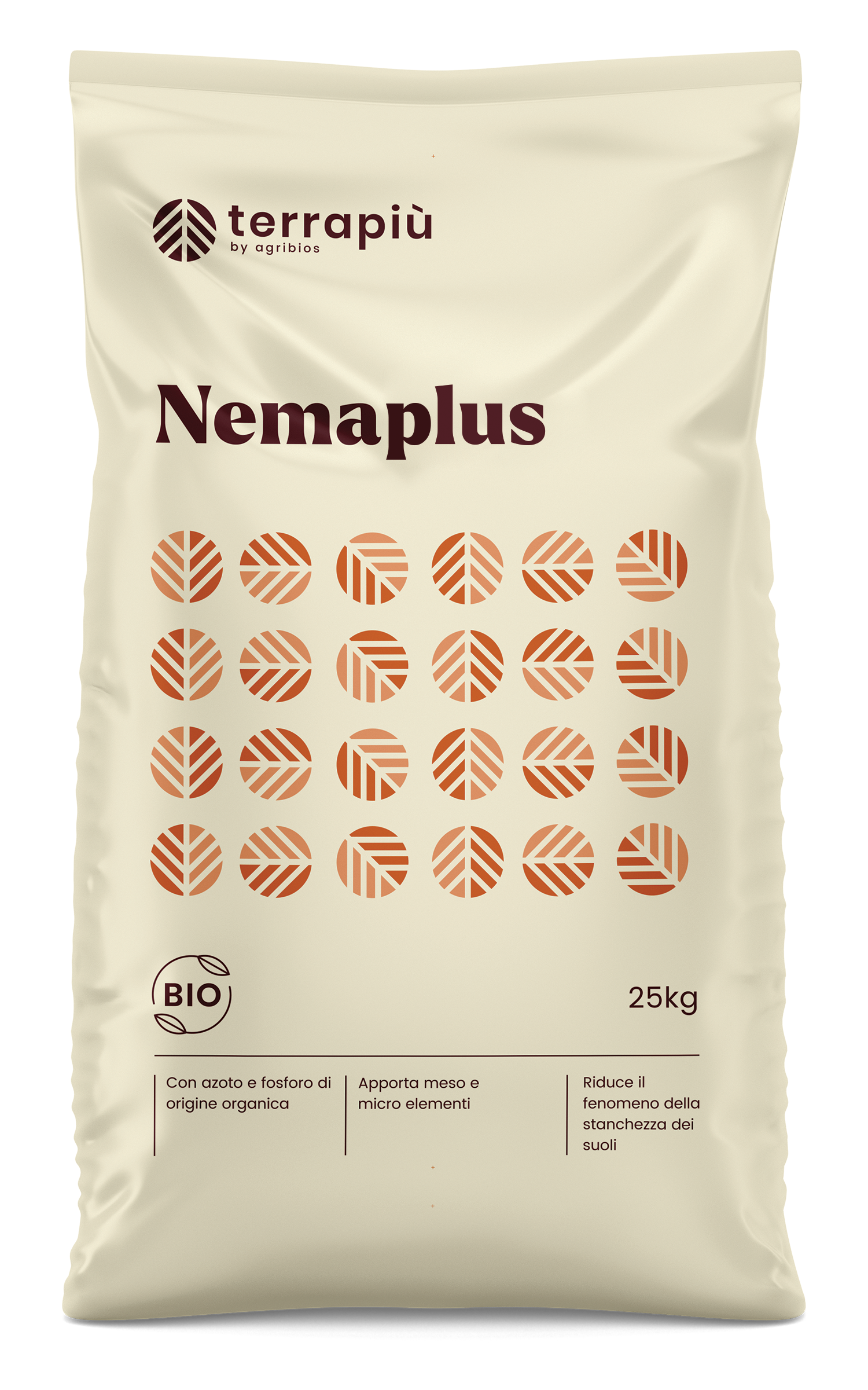
Nemaplus is an organic fertilizer containing, in addition to a highly humified organic fraction mainly composed of vegetable cakes, substances that create an environment in the soil unfavorable to the development of soil nematodes and parasitic insects while promoting the development of beneficial microorganisms. The addition of Calcium gives Nemaplus a specific action.


Prodotti correlati

Biocomplex
Biocomplex

Organo-mineral fertilizers

Agricomplex
Agricomplex

Organo-mineral fertilizers

Nemaplus
Nemaplus

Organic fertilizers

Subscribe to the newsletter

Subscribe now
immagine icona della newsletter
Agribios Italiana s.r.l.
Yara