As spring approaches—the phase of vegetative awakening for tree crops and of sowing/transplanting for many herbaceous crops—special attention must be paid to fertilization, whether applied to support the restart after winter dormancy (tree crops) or as a base fertilization (herbaceous crops).
Raw materials and formulations
•
9 March 2026
9 March 2026
Fertilizers with an organic matrix: humification as an index of efficacy and efficiency
Soil-oriented fertilization strategy
Any modern and rational fertilization strategy must aim to meet the nutritional needs of the crop but must also—now indispensably, under penalty of jeopardizing the long-term sustainability of agricultural practices—focus on respecting the soil and on the protection and regeneration of its physical and biological, as well as chemical, properties.
While these are the goals, choosing the right fertilizers is far from simple and requires a series of evaluations.
Prefer organic matter
If fertilizing also means contributing to soil vitality, organic matter cannot be excluded from this agronomic practice, as regenerative agriculture strongly emphasizes.
This is due to the beneficial effect of organic matter on agricultural soils, particularly regarding:
- porosity;
- cation exchange capacity;
- water-holding capacity;
- mitigation of degradation phenomena such as salinity and salinization;
- microbiota balance—especially in the rhizosphere—an effect that is enhanced when using organic fertilizers inoculated with beneficial microorganisms.
Deciding whether to use organic fertilizers or organo-mineral fertilizers depends on:
- the crop;
- the soil type;
- application timing;
- soil–crop–climate interactions, i.e., the cropping context;
- the presence of crop rotation (for herbaceous crops);
- the presence of cover crops and/or green manure (for tree crops).
Organo-mineral fertilizers are particularly beneficial when the crop needs part of the nutrients—supplied by the mineral fraction—in a short timeframe, while benefiting later from the gradual release of nutrients provided by the organic fraction.
High-quality organic matter: what sets it apart?
Selecting which organic or organo-mineral fertilizers to rely on means carefully evaluating the origin of the organic matrix used in their formulation and the processes applied to it.
We have already explored the origin and characteristics of organic matrices such as compost and digestate, comparing them with well-matured manure, and highlighting the superior agronomic (physical, chemical, and biological fertility) and environmental performance of the latter—reduced nutrient losses and maximized efficiency in crop uptake.
This superiority derives primarily from two characteristics: a favorable C/N ratio (around 20–30:1) and a high humification rate. The latter—indicative of the abundance of humic and fulvic acids—is the main index of the overall efficiency of an organic or organo-mineral fertilizer. These substances chelate the nutrients released by the organic fraction and make them available to plant roots.
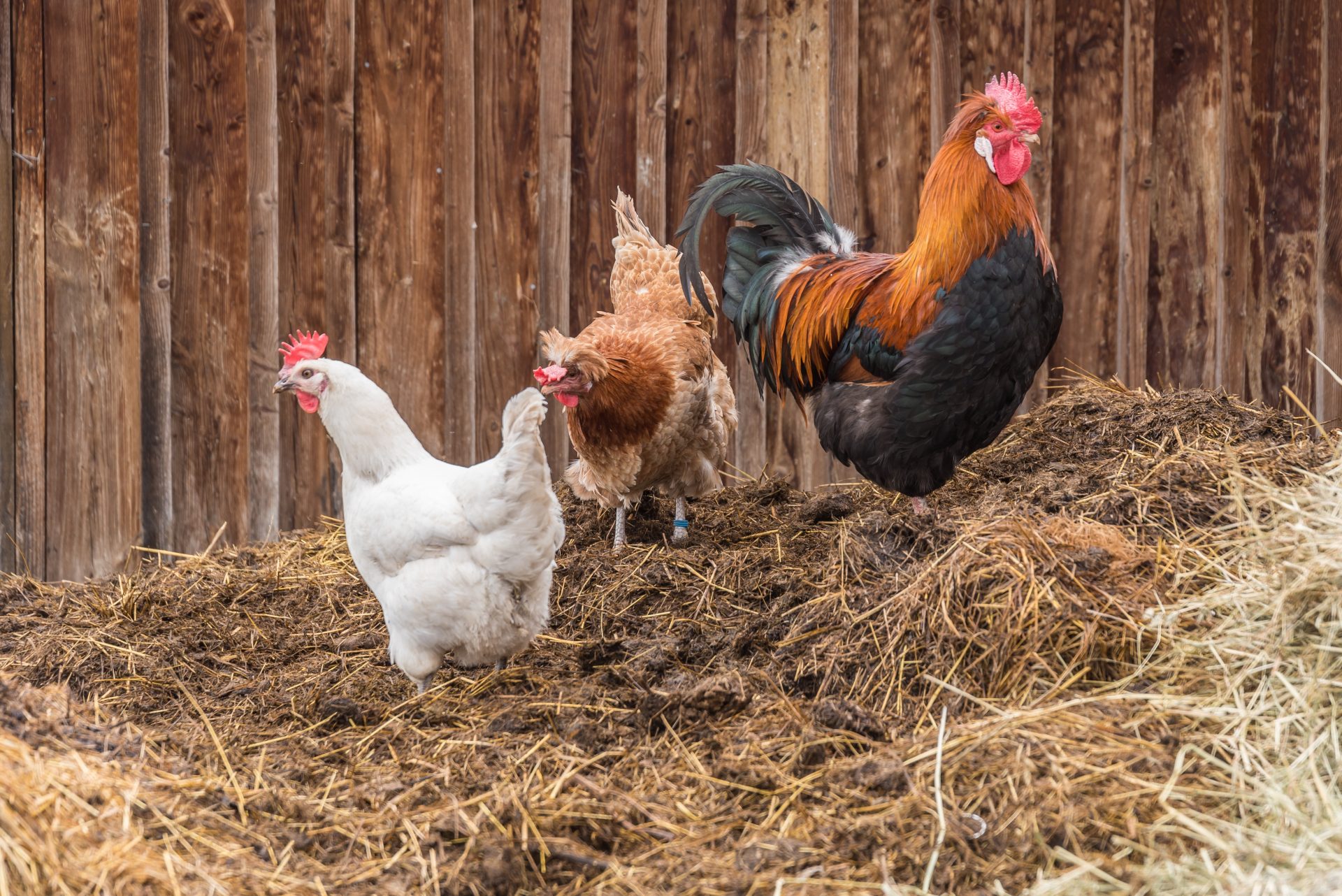
In well-matured manure, the humification rate is 40–50%, twice that of solid digestate.
Humified organic carbon: the true key player
Of all the carbon present in an organic matrix, the humified fraction plays the most crucial role in determining the efficiency of an organic or organo-mineral fertilizer.
For this reason, Agribios Italiana pays particular attention to the maturation process applied to organic matrices, especially manure, used in its fertilizers.
This is a natural process, carried out in covered and naturally ventilated structures, without the use of drying ovens.
A slow process that results in high real fertilization efficiency in terms of macroelements, equal to 70-35-70% NPK for a highly humified organo-mineral fertilizer, compared with 50-15-45% for an organo-mineral based on non-composted poultry manure.
This process not only reduces pathogenic load—potentially harmful to human health—but also causes a progressive lowering of pH, initially basic, toward near-neutral levels, the range in which macroelements and most meso- and microelements (except Iron) are most bioavailable.
How much organic carbon is found in organo-mineral fertilizers?
What is the typical organic carbon content of an organo-mineral fertilizer?
Current fertilizer legislation (Legislative Decree 75/2010 and amendments; EU Regulation 2019/1009; Directive 90/667/EEC) requires that organo-mineral fertilizers must report their organic carbon content on the label, and this value must not be lower than 7.5%.
In Agribios Italiana organo-mineral fertilizers, the percentage of organic carbon is significantly higher than the legal minimum, and the humification rate is particularly high.
Agribios tips
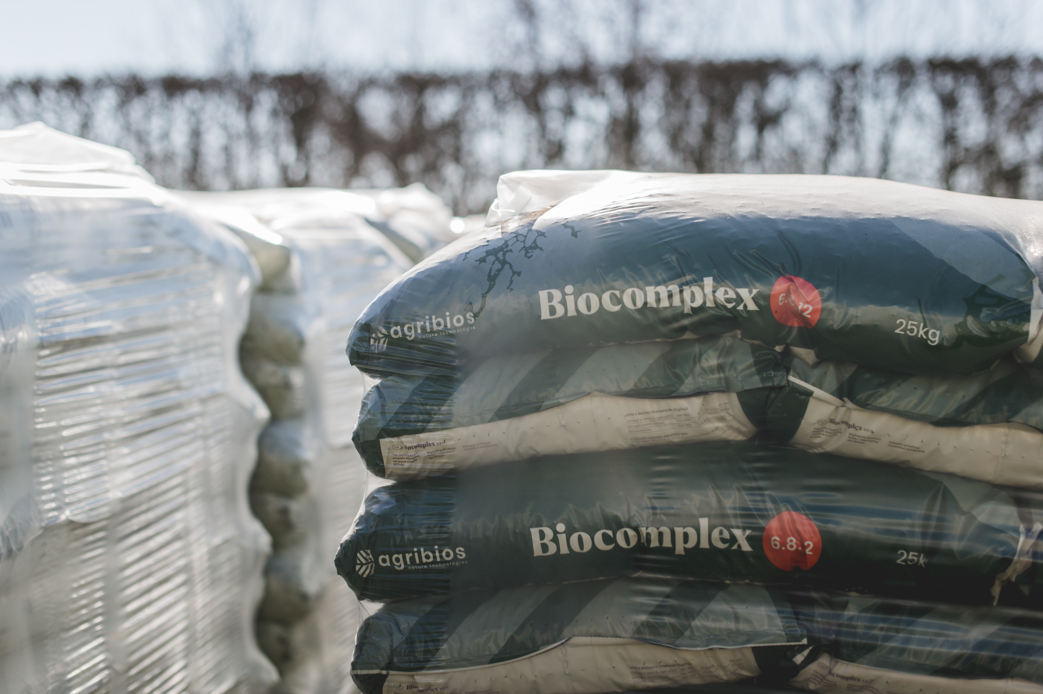
Biocomplex 6.8.12 is an organo-mineral fertilizer (Organic carbon: 23%) produced from a blend of organic fertilizers rich in Nitrogen and Phosphorus, combined with potassium sulfate.
This creates a complete fertilizer containing all essential nutrients in ideal ratios. Biocomplex 6.8.12 ensures both rapid and long-lasting fertilizing action, with gradual release of all its organic Nitrogen, enabling a single application at the beginning of the crop cycle.
It also promotes intense microbial activity in the soil, enhancing fertility. Its synergy of free amino acids and humic acids supports rapid root activity recovery, even under stress conditions such as extreme temperatures. Essential elements like Potassium, Magnesium, Calcium, Sulfur, and numerous micronutrients (Iron, Manganese, Boron, Copper, Zinc) are also present.
Ortofrutta 5.9.16, an organo-mineral fertilizer (Organic carbon: 13%), allows, with a single application, the supply of both mineral nutrients (N, P, K) and a significant quantity of highly humified organic matrix, obtained from a blend of premium-quality manure naturally fermented for about 180 days in covered, ventilated facilities. This long maturation process reduces moisture content, enriches organic matter with humic acids, neutralizes pH, and sanitizes the mass, making it free of nematodes, Salmonella, pathogens, antibiotics, and weed seeds.
Prodotti correlati

Biocomplex
Organo-mineral fertilizers

Ortofrutta
Organo-mineral fertilizers

Subscribe to the newsletter
Subscribe now
