Fertilization schedules •
7 March 2025

How to prevent and treat iron chlorosis

A plant physiological illness caused by iron deficiency in plant tissues, which leads to reduced chlorophyll synthesis, iron chlorosis is a critical issue as widespread as it is feared in agriculture.

Spring is approaching and with it the vegetative awakening of tree crops, during which intense metabolic activity could bring out iron-deficiency problems. This is due to the high probability that predisposing conditions will occur in soils, namely high humidity and low temperatures. But even annual crops, such as vegetables, cereals and industrial crops, can show iron-deficiency symptoms.

As always, it is important to “know the enemy” to establish the most appropriate strategy for managing the problem, where present.

What is iron chlorosis and how does it occur

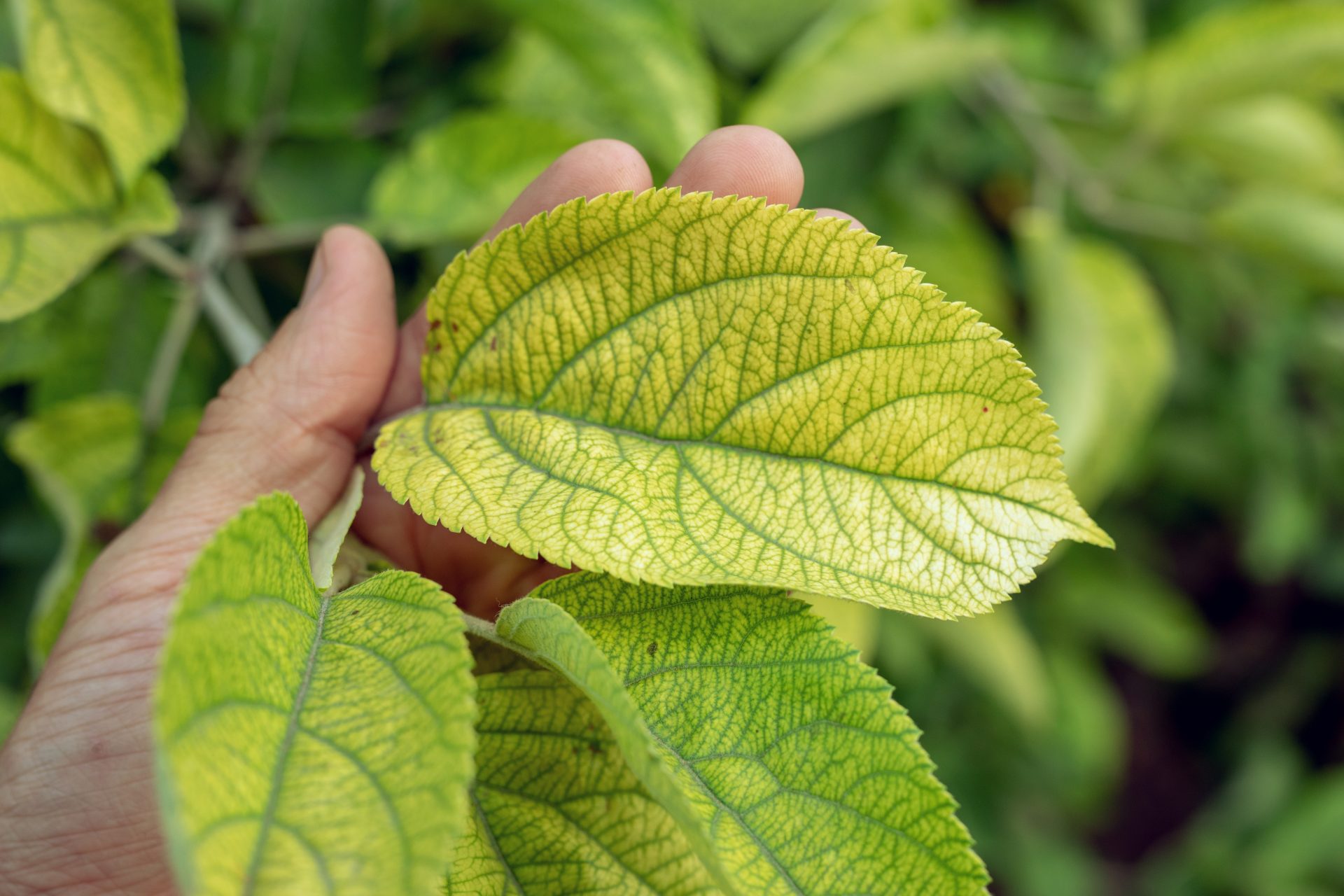
Iron is an essential element for photosynthesis and other basic metabolic processes for plant life (such as respiration, DNA synthesis and hormone synthesis), being an integral part of enzymes that intervene in these processes. The lack of iron translates into visible symptoms in the appearance of the plant, the main of which is a widespread internerval yellowing of the leaf blades, which may be followed by significant decreases in yields and production quality. Even the roots can undergo morphological changes when affected by iron chlorosis, with the formation of many root hairs.

As we have already mentioned in this article, iron chlorosis is particularly common in soils with a high pH, characterized by a high content of active limestone and a high presence of oxygen. Under such conditions, iron becomes insoluble and therefore unavailable to plants. Iron deficiency may also be the result of antagonism with other nutrients and may occur in conjunction with high absorption of Calcium, Magnesium, Zinc and Copper.

Diagnosing iron chlorosis

If our crops show symptoms attributable to iron deficiency, it is advisable to ascertain their origin and, if necessary, carry out a ‘differential diagnosis’. Some plant diseases and These disorders can in fact cause symptoms similar to those of iron deficiency.

Nitrogen or Magnesium deficiencies, for example, cause leaf yellowing similar to those caused by iron chlorosis but distinguishable from the latter because they mainly affect old leaves, while Iron deficiency occurs on young and newly formed leaves, since Iron is not as mobile in the plant. In the most severe cases, these leaves take on a white color, with a necrotic border.

Similarly, some viral yellowing could be confused with iron chlorosis, but while the former affects the entire leaf strip, iron deficiency spares the veins, which normally remain green or in any case take longer than the leaf strips to discolour. And compared to the plot, yellowing of a biotic nature is normally widespread everywhere, while in the case of iron deficiency, it is often only plants from areas above the ground with predisposing characteristics that show symptoms.

In case of doubt, to establish the most appropriate interventions and avoid unnecessary or even harmful fertilization (the administration of excess chelates can cause phytotoxicity phenomena), both soil analysis and analysis of the composition of the leaf blades can help.

The Lindsay and Norwell method quantifies the microelements that can be assimilated by the soil, including iron. The method is based on the ability of DTPA (diethylenetriaminopentacetic acid) to make these microelements soluble and assimilable. Assimilable iron in soil is considered to be poor if between 0 and 4 ppm, average between 4 and 8 ppm, and high above 8 ppm.

As for the iron content in leaves, although it varies greatly in different crops, levels lower than 50 ppm are indicative of a deficiency (with the exception of cereals, whose leaf blades are normally lower levels).
Iron chlorosis in herbaceous crops

Strawberries, green beans, cauliflower, Brussels sprouts, beans and tomatoes are particularly sensitive to these physiological illnesses, with a higher incidence when cultivated under a greenhouse. Definitely less sensitive are the potato and beetroot. In cereals, yellowing passes rapidly from the youngest to the oldest leaves.

Iron chlorosis in tree crops

In vines, iron chlorosis can lead to coulure and shrivelling and, in the most serious cases, to rickets of vegetation and loss of production.

Among citrus fruits, in which iron chlorosis can cause strong production contractions, lemons are particularly susceptible.

In the olive tree, it can lead to yellowing and depreciation of the fruits (if for eating) and to a decrease in the stability and concentration of carotenoids in the oil (if from the mill).

Among the pome fruits, the pear is particularly sensitive to iron deficiency, while among the stone fruits the peach tree is particularly sensitive to iron.

Agribios Tips

In the above-mentioned article, the importance of adopting correct agronomic practices (including maintaining and increasing the organic matter supply of soils) to discourage iron chlorosis was emphasized, and the possible critical issues deriving from fertilization with synthetic chelators were highlighted.

Furthermore, it highlighted the usefulness of fertilization with products based on humidified organic matter, containing humic and fulvic acids, which are actually natural chelators. Foliar fertilization can be useful in managing iron chlorosis, but one must keep in mind that its action is not persistent and that the young green organs formed after the application do not benefit from it, requiring repeated applications over time.

Correctives

Ferrous sulphate is used to combat iron deficiency in the main agricultural and ornamental crops. The presence of Sulphur and Iron, together with a strongly acidic pH (2.5) and the particular fluidized formulation, make Ferrous Sulphate a highly effective corrective.

Fertilizers

Novità 2025, Agrinutrient Bio is a pelleted fertilizer based on ferrous sulphate with Magnesium and Sulphur, specifically designed to provide Iron, Sulphur and Magnesium to soils. Iron is necessary for photosynthesis and respiration. Magnesium plays an irreplaceable role in photosynthesis and improves the resistance of plant tissues as a substitute for calcium. Thanks to its acidic pH, Agrinutrient BIO is particularly used in alkaline soils, rich in active limestone, where it performs a corrective action. In addition, the acidic reaction of the product and the high sulphur content, reduce the insolubilization of iron that occurs in alkaline and limestone soils.

Fumier Fer 80-20 is derived from the homogeneous mixture of humidified manure, partially hydrolyzed animal proteins and ferrous sulphate heptahydrate. The humic acids contained in it bind to bivalent iron, through carboxylic and phenolic bonds, with formations of iron humates. The completely natural chelation then makes bivalent iron available to plants. The presence of sulphur, in addition to acidifying the soil, established an important contribution of this meso element.

Fumier Sulfer is derived from the homogeneous mixture of humidified manure, partially hydrolyzed animal proteins, micronized sulphur, ferrous sulphate heptahydrate and magnesium. The humic acids contained in it bind to bivalent iron, through carboxylic and phenolic bonds, with formations of iron humates. The completely natural chelation then renders iron available to plants. It is the ideal fertilizer for all iron, sulphur and magnesium greedy crops,  such as vegetables (spinach, chard and lettuce) and ornamental plants. It is also ideal for tree plants such as kiwi, cherry and grapevine.

Ferrous sulphate, Agrinutrient Bio, Fumier Fer 80-20 and Fumier Sulfer are allowed for use in organic farming.


Prodotti correlati

Solfato ferroso
Solfato ferroso

Conditioners and correctives

Fumier Sulfer
Fumier Sulfer

Organic fertilizers

Fumier Fer
Fumier Fer

Organic fertilizers

Subscribe to the newsletter

Subscribe now
immagine icona della newsletter
Agribios Italiana s.r.l.
Yara