Crop focus •
27 June 2025

Supporting Italian corn production with organo-mineral fertilization

Since 2012, Italy has witnessed a significant reduction in grain corn cultivation areas, which have nearly halved by 2024, settling at just under 500,000 hectares.

This decline stems from both agronomic and market factors. Notably, many fields previously dedicated to corn have transitioned to oilseed crops, particularly in northeastern regions like Friuli-Venezia Giulia, which, along with Piedmont, Lombardy, Veneto, and Emilia-Romagna, comprises over 90% of Italy’s corn production .

Italian corn needs a relaunch

The abandonment of corn cultivation is mainly due to the widespread decline in yields (the national average yield in 2024 was 99 quintals/hectare, with lows of 57 q/ha in Friuli), essentially caused by climate change, difficulties in managing water supply (which is crucial for this crop), and a general increase in production costs. These trends are accompanied by a pressing need for innovation in the varietal landscape.

This situation, which has obviously led to increased national dependence on corn imports—particularly from the United States and Ukraine—puts many DOP and IGP productions at risk, especially cheese and cured meats, which play a key role in Italy’s trade balance. Grain and silage corn are in fact essential for livestock farming: in Italy, about 70% of grain corn is destined for animal feed, 20% for the starch industry, and 10% for semolina production.

Fertilization emerges as a key technique to support the production of Italian corn, especially in such a challenging agronomic context.
The nutritional needs of corn

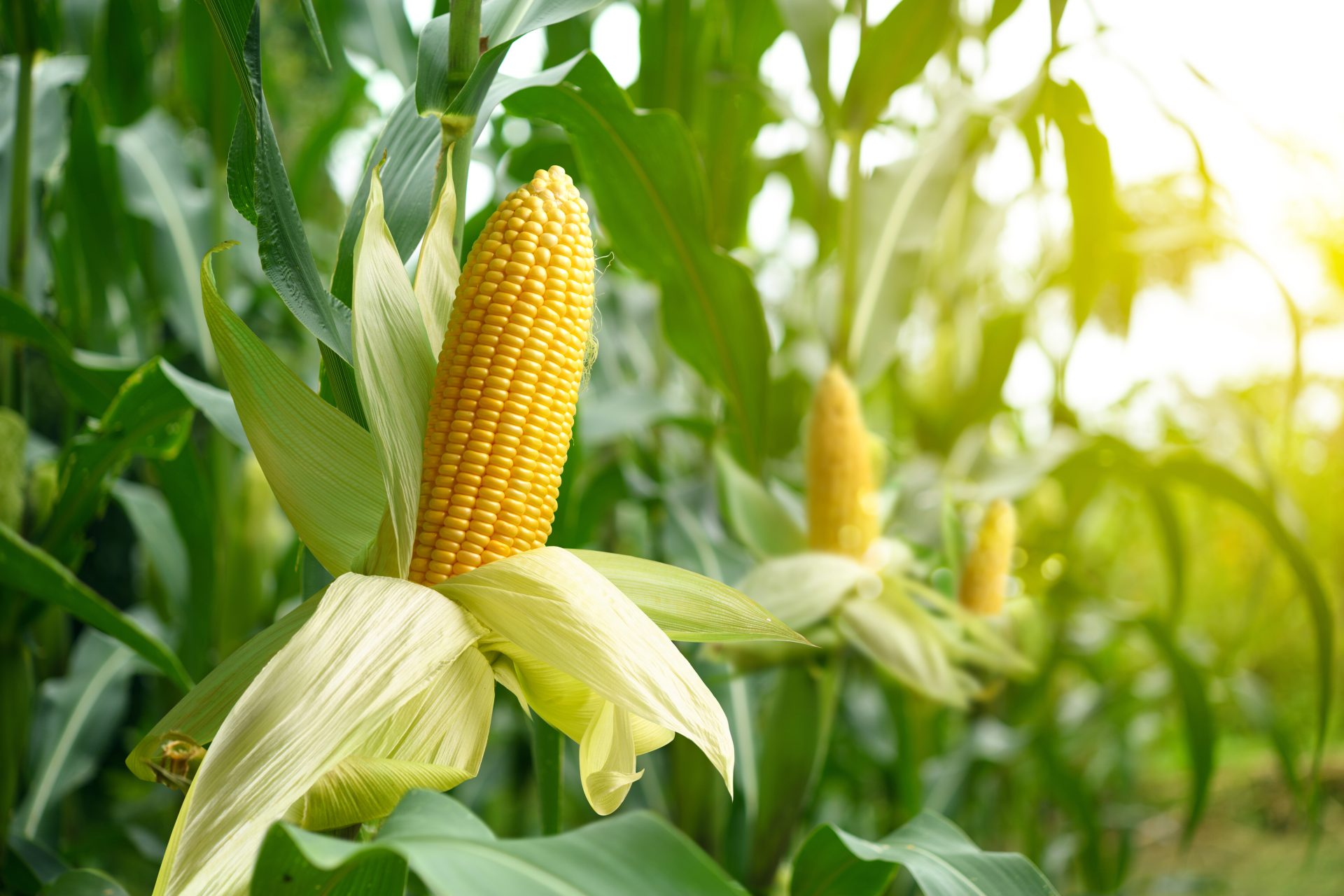
Corn is a crop with high requirements for nitrogen and potassium, and lower needs for phosphorus nutrition—although phosphorus plays a fundamental role in the early growth stages due to its well-known starter effect on rootlet development. For this reason, it is recommended to apply the full annual dose of phosphorus between pre-sowing and sowing, in a localized manner. Also in pre-sowing, the full dose of potassium and about one-third of the nitrogen requirement should be applied, with two further top-dress nitrogen applications planned.

Naturally, the total quantities of nutrients to be applied annually will strongly depend on the soil composition, expected yields, the adopted cultivation system (continuous cropping or rotation), and whether the crop residues from the previous cycle have been incorporated into the soil.

Why choose organo-mineral fertilization for corn?

The fertilization plan outlined above is designed for nutritional strategies based exclusively or mainly on the use of mineral fertilizers. However, the introduction of organo-mineral fertilizers allows for numerous advantages—provided that the essential condition for achieving quality and yield objectives is met, namely the use of products formulated with high-quality organic matrices.

Among the advantages offered by organo-mineral fertilization in corn cultivation:

  • reduction in the number of applications needed, thanks to the combination of readily available nutrient fractions and slow-release components;

  • reduction in applied doses, due to the higher efficiency of fertilizer units and lower nutrient losses through leaching and volatilization, resulting in less environmental impact;

  • positive effect on soil structure and consequently on its ability to absorb and retain rain and irrigation water;

  • beneficial impact on soil microbiota composition and subsequent mobilization of phosphorus reserves already present in the soil but in insoluble forms.

Agribios tips

Superprimo 9.20, an organo-mineral fertilizer, allows for the application of both a mineral fraction containing nitrogen and phosphorus and a high quantity of highly humified organic matter in a single pass. This organic matter is composed of a mixture of manure (bovine and poultry) and processed, partially hydrolyzed animal proteins. This blend maximizes the protection of the nutrients—nitrogen, phosphorus, but also calcium, sulfur, and zinc—contained in the product, improving fertilizer efficiency and allowing a reduction in applied fertilizer units with equivalent results. Superprimo 9.20 is particularly suitable for base fertilization of cereals, legumes, oilseeds, and all horticultural crops where stimulating root system development is necessary. Superprimo 9.20 is the natural replacement for nitrogen- and phosphorus-based mineral fertilizers currently on the market.

Agriazoto 300 is a high-titre nitrogen organo-mineral fertilizer designed for optimal fertilization of nitrogen-hungry crops. The specific composition of the organic matter and the nitrogen forms it contains ensure both rapid and gradual nitrogen release, effectively supporting the crop’s development and nutritional needs. Rich in organic matter that helps maintain soil fertility and protects nitrogen from volatilization and leaching, Agriazoto 300 offers greater nutritional efficiency compared to conventional nitrogen fertilizers.


Prodotti correlati

Agriazoto
Agriazoto

Organo-mineral fertilizers

Superprimo
Superprimo

Organo-mineral fertilizers

Subscribe to the newsletter

Subscribe now
immagine icona della newsletter
Agribios Italiana s.r.l.
Yara