Crop focus •
7 March 2025

Support table vines with the correct fertilization

On the one hand, the contraction in the harvest, determined in 2023 by the damage caused by late blight and in 2024 by drought (but also by a certain reduction in production areas), on the other hand, an undeniable liveliness of the productive fabric and an excellent quality level of the product collected this year.

Light has been heavily shed when analyzing the very recent Ismea report on the trend of the table grape supply chain in Italy, where we read of attractive original prices and upward buying trends.

Located mainly in Puglia and Sicily, where more than 95% of the invested surface is located, Made in Italy table viticulture involves highly specialized entrepreneurs, often united in Producer Organizations, in constant and proactive dialogue with the market and large retailers, buyers of primary importance for this product.

The forecasts for the export trend are also good: “The forecasts for the balance of the trade balance of table grapes are optimistic, since, as it happened in 2023, the increase in the export price should compensate for the decline in volumes shipped,” reads the aforementioned Ismea Report.

A significant change in the balance of cultivated varieties should be noted, with apyrenes growing strongly for some years now.

The nutritional needs of table grapes

Despite the significant differences between wine and table grape varieties, it is always Vitis vinifera. From a qualitative point of view, the necessary nutrients are the same as those of the wine grape vineyard, but the doses will change depending on the different production objectives (for example, lower sugar content in the case of table grapes) as well as the intrinsic characteristics of the individual varieties, in terms of productivity and ripening period.

The principles on which to base a correct fertilization plan are similar to those valid for the wine grape vineyard. However, keep in mind that in table viticulture, the presence of an irrigation system is the key rule and that it will therefore be easier to resort to liquid products if needed (for example, treatment of specific deficiencies during the season).

Even in table viticulture, it is necessary to take into account the two peaks of radical activity, which are in October – November (i.e. post-harvest or with grapes still in the plant in the case of a late-harvest variety) and in spring. Autumn fertilization, especially with products able to support the absorption peaks of the pre-vegetative rest phase but at the same time to ensure a slow release of elements over time, is particularly important to return to the soil the removals of the season that is about to end, but also to promote a more ready and balanced vegetative awakening in the following spring. Organo-mineral fertilizers are particularly useful for this purpose.

What the 2024 season taught us

In the 2024 production season, table viticulture in Southern Italy suffered dramatically the effects of a prolonged drought associated with high temperatures during the ripening season. The combination of these factors leads to multiple summer stresses that, consequently, cause a slowdown in photosynthetic activity, with imbalances in maturation, and sometimes negatively affect the colour of the skins, with negative effects on the appearance of the bunches.

The use of irrigation has often been necessary to counteract the effects of adverse weather trends, but this has not always been possible at optimal times and volumes, due to the reduced availability of water resources.

In a context like the current one, where the current climate changes and the scarce availability of good quality fresh water for agricultural use are a fact, it is necessary to think about the fertilization of a crop such as table grape, that has important water requirements, not only in terms of satisfying nutritional needs but also of safeguarding and increasing the supply of soil in organic matter.

This has a positive impact on the physical and microbiological properties of the soil, and also promotes a more efficient storage of rainwater and irrigated water in the soil.

Of course, the preparation of rational fertilization plans must be accompanied by all other agronomic techniques capable of improving water use efficiency by the plant, such as the correct management of vegetative-productive balance, and optimizing water distribution, such as drip irrigation systems.

Agribios Tips

Agri Bio Aktiv is a soil activator made of  humidified organic matter and bacterial and fungal inoculums. In addition to providing organic matter and nutrients, it promotes and directs the proliferation in the soil of microorganisms useful for the development of plants. Furthermore, its particular microbial composition, rich in Trichoderma harzianum and viride and in rhizosphere bacteria, limits the development of pathogens, with various mechanisms of action, responsible for certain diseases of the root system such as Fusarium, Pythium, Armillaria, Sclerotinia, Phytophtora and Rhizoctonia.

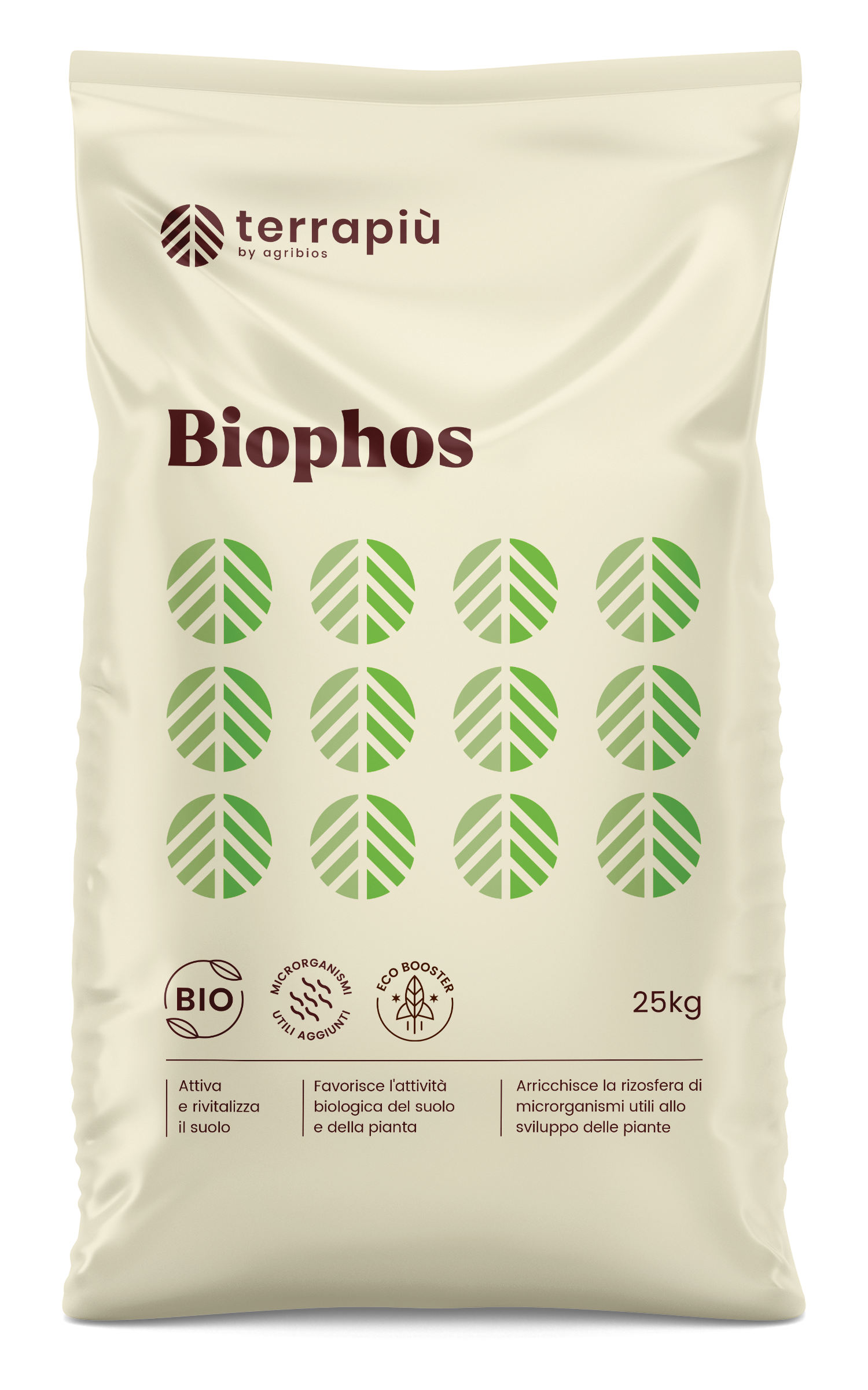
Biophos is a highly innovative multipurpose organic fertilizer, allowed in organic farming. In addition to providing humidified organic matter of high agronomic quality with soil regenerating action, it contains a specific pool of rhizosphere bacteria that, through enzymes such as alkaline phosphatase and phytases, act on the insoluble forms of phosphorus present in the soil, making the element available again for crops.

Ortofrutta Special 12.7.5  provides, in a single step and together with the mineral fraction containing nitrogen with gradual release (60-90 days), phosphorus and potassium, a significant amount of highly humified organic matrix of meso and micro elements, among which Sulphur and Magnesium stand out. The organic matrix of Ortofrutta Special 12.7.5 consists of a mixture of highly humidified manure, naturally fermented for a total period of about 180 days in a covered and ventilated place. This long period of maturation reduces the moisture content, enriches the organic substance with humic acids, neutralizes the pH and sanitizes the mass, rendering it free of nematodes, salmonella, pathogens, antibiotics and weeds seeds.

In addition to improving soil characteristics, Ortofrutta Special 12.7.5 protects nutrients from losses due to runoff thanks to the chelating action of the humic acids contained in the organic substance.


Prodotti correlati

Agri Bio Aktiv
Agri Bio Aktiv

Fertilizers with microorganisms

Biophos
Biophos

Fertilizers with microorganisms

Ortofrutta Special
Ortofrutta Special

Organo-mineral fertilizers

Subscribe to the newsletter

Subscribe now
immagine icona della newsletter
Agribios Italiana s.r.l.
Yara